Silver Sky Research Subject Detention Status
The Werewolf Mates Anthology (Erotic Romance)Silver Sky captivity is the hidden imprisonment of people targeted by Silver Sky Research’s unauthorized human experiments. It strips its subjects of privacy, reliable information, and ordinary protection while the company manages their bodies and whereabouts through cells, surveillance, guarded access, and a fabricated account of their absence. Abigail McKinney’s confinement reveals the bodily and psychological cost of that system; Jacob Pitman’s attempts to rescue her and his sister Jaz show how its controls extend beyond the cells to cameras, alarms, records, and threats against family members.
Subjects and Routes into Confinement
Abigail’s captivity begins after she falls ill at work. She had felt sick throughout the morning, and when Dr. Damien Greggs came to discuss her latest report, she collapsed before they had spoken for more than a few minutes. She later woke in a cell, unable to identify who had taken her. The abrupt passage from an office conversation to confinement leaves her with no clear account of what happened between the two. She had been held for three days by the time two armed men dressed in black dragged her out; she had heard another woman in a separate cage, but their captors prevented them from speaking.
Jaz’s disappearance gives Jacob’s search a longer history. She had taken a job at a Silver Sky Research facility in Montana four months earlier and vanished after one month. The company stonewalled Jacob, while the police found nothing. Her ex, Rodney Gilcrist, eventually supplied a lead: a story that the company was experimenting on its employees in Idaho. Jacob found the information easier to obtain than he expected and concluded that Jaz was at the facility he targeted. The account presents this as the lead that sends him into the institution, not as proof that every detail of Rodney’s report is correct.
The Cell and the Captive Body
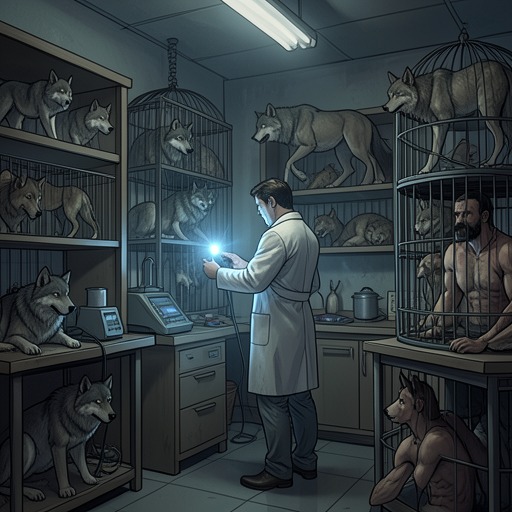
Abigail’s cell is organized for observation rather than dignity. Her bed, toilet, and tiny sink are all visible to her captors, and she has been unable to do more than splash herself clean. She compares the lack of privacy unfavorably even with jail. The cell reduces basic bodily needs to activities conducted in full view, making confinement an ongoing intrusion rather than simply a locked door.
Her physical condition is also changing while she is imprisoned. Three days after waking from a coma-like state, she feels a wild force within her responding to the moon rising outside. She tries to suppress it, but her behavior becomes increasingly uncontrolled: she laughs, tears at a small pillow, and loses her sense of time, self, and moral distinction. In that state, her attention fixes on Jacob when he appears at the cell. The episode connects captivity to an altered bodily experience without resolving exactly what the company did to her. Later, when Kelly Shaw asks about the previous night, Abigail says she was not on vacation; she has trouble believing that the organization where she had worked for more than five years would betray her, including Dr. Damien Greggs.
The company’s explanation of absence compounds the imprisonment. Kelly reports that Dr. Damien Greggs announced Abigail had gone on vacation, although Kelly knew of no such plan and expected Abigail would have told her. The false account helps explain why a colleague might not immediately search for her, while Abigail’s return makes the discrepancy undeniable. Max tells her that Silver Sky Research is doing more than studying wolf migration patterns. Kelly and Max identify unauthorized, unvetted human testing and say Abigail appears to have been selected as a subject. Abigail connects the timing to Dr. Damien Greggs’s arrival in Boise, though the evidence does not establish the exact process by which she was selected.
Rescue and the Reach of Security
Jacob’s first infiltration is built around a short security gap. After planning for more than a month, he enters at 12:37, when guards are expected to change positions, using an identification card he stole earlier that day. He intends to disable the cameras, loop in dummy footage at an unmanned station, turn off holding-cell sensors, unlock doors along his route, and trigger a false alarm elsewhere. He sets off the alarm in the south quadrant and leaves with only thirty seconds before the next guard is due at the station. The ordinary-looking corridors—beige walls, fluorescent lights, office windows, name tags, and paintings of wolves and other wild animals—contrast with the hidden detention behind them.
Jacob gets Abigail out, but escape from the cell does not immediately mean safety. He takes her to the dingy motel where he is staying, hands her the shirt she had thrown aside, and helps her put it on. Her wristband gives him her name, Abigail McKinney, along with a number and a date whose significance he does not know. He has paid cash, and the getaway truck is untraceable, but the company’s wider response soon shows that the escape has not ended the danger.
Jacob considers returning to the facility because his primary purpose remains finding Jaz. He leaves by back roads and sees several black SUVs speeding past him; recognizing that the breach has been discovered, he parks more than a mile from the facility, hides his truck under branches, and approaches on foot. From a tree he watches the perimeter and sees that security has doubled. A tracking chip in the access card he used alerts him to a further weakness in his plan: with the facility in sight, he may be close enough for its computer to detect the card. The same credential that opened the way in can therefore help the institution locate the intruder.
Recapture and Coercion
After Jacob is recaptured, he wakes in a cell like the one from which he freed Abigail, with a cot, toilet, and sink but no mirror or window. Cameras along the corridor let his captors see that he is awake. He learns that Jaz is also being held nearby. When he asks whether she is all right, she says the company did something to her and describes being taken somewhere else the previous night, where she fought violently and could not stop. Her account establishes that the abuse extends to Jacob’s original target, not just Abigail.
Silver Sky’s control over the siblings becomes explicit when a doctor arrives with a syringe and a businessman offers Jacob a bargain. If Jacob approaches the bars, allows himself to be handcuffed, and takes the medicine without resistance, Jaz will be released. If he tries anything, the man threatens to make Jaz bear the consequences. He promises she will be released in her current condition with a change of clothes, but warns that if she goes to the police, Jacob will be killed before they arrive. The transaction presents compliance as a choice while making the threat against Jaz the condition that governs it.
Even after that coercion, Jacob later tries to escape. An attendant leaves his tray of undercooked red meat on the floor; Jacob has been given only red meat since waking and is tired of it. He uses a missing keycard to unlock the cage from outside the bars, but the attempt lasts only two steps into the corridor. An alarm sounds, red lights flare, and a guard points a gun at him. Too far away to fight and too close to flee, Jacob raises his hands. The alarm and rapid armed response make clear that the facility has learned from the earlier breach and that possession of an access card alone cannot overcome its security.
Institutional Concealment and Significance
The captivity is sustained not by cells alone but by a network of controlled information and access. Elsewhere, Kelly recalls that after an incident on the twenty-eighth, a server crash was described as unrelated, a file share became password-protected, and an IT worker came to check on her after she opened the wrong folder; the folder then disappeared from her computer. These details do not prove that the server event and the kidnappings were the same operation, and the investigation had treated the crash as irrelevant. They do show how unexplained access restrictions and missing information surround the broader inquiry into Silver Sky.
Together, the concealed absence, watched cells, instrumented security, threats, and manipulated access make Silver Sky captivity an institutional condition rather than a single episode of physical restraint. Its subjects are treated as people the company can isolate and experiment on, while family, coworkers, and investigators are kept from understanding where they are or why. Jacob’s repeated efforts expose both the vulnerabilities in that system and its capacity to respond: a brief opening allows Abigail’s rescue, but tightened guards, tracking technology, and coercion restore the company’s control. The account leaves that conflict unresolved at this point, with Jacob still imprisoned and Jaz’s release promised under threat rather than secured.